
What does this procedure involve?
Sacral neuromodulation (SNM) is also sometimes called sacral nerve stimulation (SNS). The procedure involves placing a wire in your lower back, near the nerves that control your bladder and bowel. This wire delivers small electrical pulses and helps to improve problems with bladder and bowel function.
It is used to treat the following conditions:
- Overactive bladder – urgency (the sudden need to pass urine which you cannot put off) with or without urine leakage, frequency (passing urine more often than normal) and nocturia (getting up from sleep to pass urine twice or more at night)
- Non-obstructive urinary retention (inability to empty the bladder) in females
- Faecal (bowel) incontinence – and some other bowel problems
For bladder problems, the success rate of SNM is around 70%, meaning that patients report a significant improvement (not cure) in their symptoms. Not all patients, however, are suitable for SNM treatment.
What are the alternatives?
SNM is used to treat two different conditions:
Overactive bladder (OAB)
OAB can be treated without surgery. We recommend that all patients try conservative treatments before having an operation, because it avoids the risks of side-effects or complications of surgery. Treatment options include:
- Incontinence pads – if your symptoms are not a bother you may choose to do nothing and use pads for urine leakage
- Conservative measures – including weight loss, improving fluid intake and reducing caffeine & alcohol intake
- Bladder training – learning techniques to hold on and over-ride your urge to pass urine
- Medicines – these may help if conservative treatment does not work
Sacral nerve stimulation is only tried if these treatments are not effective. Other procedures that can be used include:
- Botulinum toxin-A injections – into the wall of your bladder using a telescope
- Enterocystoplasty – a major operation that enlarges your bladder using a piece of bowel
- Posterior tibial nerve stimulation, PTNS – electrical stimulation of a nerve near the ankle
Non-obstructive urinary retention
If you cannot empty your bladder, SNM sometimes helps but it is not suitable for everyone with this problem. Alternative treatments include:
- Intermittent self-catheterisation in women – passing a disposable catheter tube into the bladder through the water pipe to drain the urine
- Permanent insertion of a catheter
- Mitrofanoff procedure – a major operation to allow you to pass a catheter into your bladder through your abdomen (tummy) instead of through your urethra (waterpipe)
What happens on the day of the procedure?
You will be seen by the surgeon and the anaesthetist who will go through the plans for your operation with you.
We may provide you with a pair of TED stockings to wear, and we may give you an injection to thin your blood. These help to prevent blood clots from developing and passing into your lungs. Your medical team will decide whether you need to continue these after you go home.
Details of the procedure
The treatment involves two separate operations, several weeks apart. After the first part, there is a test phase, which allows the medical team to see if the SNS is working.
During the first operation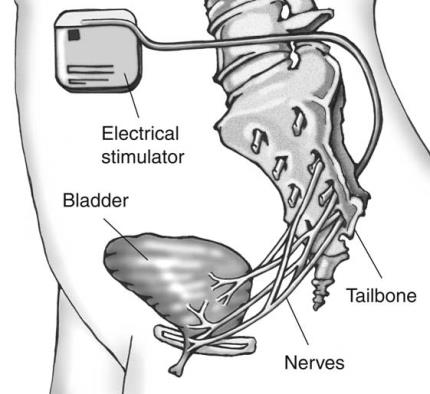
- we make a tiny incision (cut) in your lower back and a second 3–4 cm incision in your upper buttock
- we place an electrode (wire) near the nerves using X-rays to make sure it is in the correct place; the wire passes out through the skin at the side of your buttock
- we connect this wire to a stimulator box outside your body
- the stimulator box sends electrical signals to the nerves and needs to be worn all the time
- typically, you can go home on the same day but an overnight stay is sometimes needed
During the test phase
- You must keep your dressings clean and dry. This means that you cannot shower or bathe during the test phase. You can keep yourself clean by using a sponge or flannel, providing the dressings remain dry. Please do not remove or change the dressings.
- Once you get home, your urology team will monitor you closely. This is so they can check that the treatment is working well, and make any adjustments needed to the stimulator when needed.
- This phase usually lasts between two and four weeks. It is very important that you complete any bladder diaries given to you during this time, to see if the treatment is helping your symptoms.
During the second operation
If the SNM treatment does not work during the test phase, we will remove the temporary wire during the second procedure. Otherwise, you will have a permanent stimulator put in.
- we re-open the incision in your buttock and place the permanent stimulator under the skin
- depending on the type of wire put in during the first operation, we either replace it with a new (permanent) wire, or use the same wire
- you may be able to go home on the same day, but an overnight stay is sometimes needed
- you may need to take antibiotics to reduce the risk of infection
We switch your stimulator on after the procedure although, sometimes, we leave this for a few days. When it is switched on, you may feel a tapping sensation inside you. We will programme the stimulator so that you get maximum benefit without discomfort.
We will show you how to adjust the stimulator strength yourself, using a remote control-type device or smartphone.
Some permanent SNM devices are MRI-compatible, and some have a rechargeable battery; your surgeon will discuss this with you.
Are there any after-effects?
The possible after-effects and your risk of getting them are shown below. Some are self-limiting or reversible, but others are not. We have not listed very rare after-effects (occurring in less than 1 in 250 patients) individually. The impact of these after-effects can vary a lot from patient to patient; you should ask your surgeon’s advice about the risks and their impact on you as an individual:
| After-effect | Risk |
|---|---|
| Failure of the treatment to improve your symptoms significantly |
 3 in 10 patients (30%) 3 in 10 patients (30%) |
| Mild discomfort requiring simple painkillers |
 Between 1 in 2 & 1 in 10 patients (10-50%) Between 1 in 2 & 1 in 10 patients (10-50%) |
| Need for replacement, relocation or removal of the implanted stimulator or electrode (wire) |
Around 1 in 4 patients (25%) |
| Discomfort in your buttock, or lower back, at the site of the stimulator or its lead |
Around 1 in 7 patients (15%) |
| Discomfort in your ankle or foot |
Around 1 in 10 patients (10%) |
| Infection in your wound requiring antibiotics and possible removal of the device |
 Between 1 in 25 patients (4%) Between 1 in 25 patients (4%) |
| Stimulation produces an adverse (undesirable) after-effect on your bowel function |
Between 1 in 10 & 1 in 50 patients (2-10%) |
PLEASE NOTE: Other unwanted side-effects may include unexpected triggering of shop security alarms or airport security scanners. This is not harmful, but you should inform security staff if your device has triggered alarms in the past.
What is my risk of a hospital-acquired infection?
Your risk of getting an infection in hospital is between 4 & 6%; this includes getting MRSA or a Clostridium difficile bowel infection. Individual hospitals may have different rates, and the medical staff can tell you the risk for your hospital. You have a higher risk if you have had:
- long-term drainage tubes (e.g. catheters);
- bladder removal;
- long hospital stays; or
- multiple hospital admissions.
What can I expect when I get home?
- you will get some mild discomfort which may last several days and can normally be relieved with mild painkillers
- you will be given a copy of your discharge summary and a copy will also be sent to your GP
- you must keep the dressings clean and dry
- you must not shower or bathe during the test phase
- you must avoid strenuous activities, sports and any stretching of the lower back for 6-12 weeks; these can cause the wire to move out of position so that the SNM stops working
- if you get any redness, discharge or significant pain/throbbing in the wound, you should contact the hospital as soon as possible
- you may need to “fine-tune” your stimulator using the hand-held remote control or designated smartphone
- if you do have problems with the stimulator, please contact your named specialist nurse or surgeon
- a follow-up appointment will be made for you to review your response to the surgery
Are there any long-term issues with sacral nerve stimulation?
Yes, a few. The important ones are:
- Battery failure (in non-rechargeable devices) – the battery in your stimulator will run down eventually, usually after 3-7 years. Battery life depends on the settings you have been using. Changing the battery is relatively simple, and involves a procedure very like the second stage of the original implantation
- Electronic devices – security screening and airport scanning devices can affect your stimulator. Show the security staff your SNS identification card and they may allow you to by-pass the scanner. If not, make sure you turn your stimulator off before you pass through the scanner
- Surgical diathermy – cutting and sealing of blood vessels during surgery is usually done using diathermy (electrical current). After SNM, if you need a surgical procedure whatever the reason (but especially if it involves your lower back, abdomen or pelvis), your SNM device should be turned off. This is because the current from some types of diathermy equipment can damage your stimulator. Please tell your surgeon about your SNM and he/she will make sure that only safe diathermy equipment is used, and that your device is switched off during the surgery.
- Sports and strenuous activities – because of the risk of damaging or dislodging the SNS device or the lead, we advise you not to take part in contact sports, extreme sports or horse-riding
- Magnetic resonance (MR) scanning – the powerful magnetic field in an MRI scanner can damage your stimulator and cause you harm. Having an MRI scan of your head will cause no problem, but you should not have any other form of MRI scan unless you have been implanted with an MRI-compatible device. Your surgeon will clarify this if you are not sure.
General information about surgical procedures
Before your procedure
Please tell a member of the medical team if you have:
- an implanted foreign body (stent, joint replacement, pacemaker, heart valve, blood vessel graft);
- a regular prescription for a blood thinning agent (e.g. warfarin, aspirin, clopidogrel, rivaroxaban, dabigatran);
- a present or previous MRSA infection; or
- a high risk of variant-CJD (e.g. if you have had a corneal transplant, a neurosurgical dural transplant or human growth hormone treatment).
Questions you may wish to ask
If you wish to learn more about what will happen, you can find a list of suggested questions called “Having An Operation” on the website of the Royal College of Surgeons of England. You may also wish to ask your surgeon for his/her personal results and experience with this procedure.
Before you go home
We will tell you how the procedure went and you should:
- make sure you understand what has been done;
- ask the surgeon if everything went as planned;
- let the staff know if you have any discomfort;
- ask what you can (and cannot) do at home;
- make sure you know what happens next; and
- ask when you can return to normal activities.
We will give you advice about what to look out for when you get home. Your surgeon or nurse will also give you details of who to contact, and how to contact them, in the event of problems.
Smoking and surgery
Ideally, we would prefer you to stop smoking before any procedure. Smoking can worsen some urological conditions and makes complications more likely after surgery. For advice on stopping, you can:
- contact your GP;
- access your local NHS Smoking Help Online; or
- ring the free NHS Smoking Helpline on 0300 123 1044.
Driving after surgery
It is your responsibility to make sure you are fit to drive after any surgical procedure. You only need to contact the DVLA if your ability to drive is likely to be affected for more than three months. If it is, you should check with your insurance company before driving again.
Pregnancy
If you get pregnant when you have an SNM device, we would recommend that the device is switched off. If you are planning a pregnancy, SNM is not recommended because its effects on the unborn foetus are not known.