
What does this procedure involve?
The procedure involves exploration performed through a surgical incision in the scrotum. We untwist the affected testicle and fix both testicles in the scrotum with stitches to prevent further twisting. At surgical exploration, if the twisted testicle is not viable, it will be removed.
What are the alternatives?
At the moment, scans and scoring systems are not as accurate in making a diagnosis as surgical exploration. They may, however, be used to confirm alternative diagnoses. Conservative treatment, without surgery, is very likely to lead to pain and atrophy (shrinkage) of the testicle.
What happens on the day of the procedure?
Your urologist (or a member of their team) will briefly review your history and medications, and will discuss the surgery again with you to confirm your consent.
An anaesthetist will see you to discuss the options of a general anaesthetic or spinal anaesthetic. The anaesthetist will also discuss pain relief after the procedure with you.
We may provide you with a pair of TED stockings to wear, and we may give you a heparin injection to thin your blood. These help to prevent blood clots from developing and passing into your lungs. Your medical team will decide whether you need to continue these after you go home.
Details of the procedure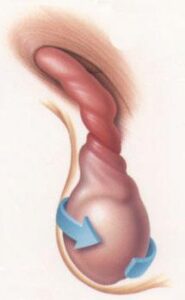
- We normally carry out the procedure under a general anaesthetic
- You may be given an injection of antibiotics before the procedure, after you have been checked for any allergies
- We make either a single incision in the centre of your scrotum, or small incisions on each side
- If torsion is confirmed (pictured), we untwist the testicle
- If the testicle remains healthy and viable after untwisting, we fix it in the scrotum with stitches to prevent further twisting
- In a small proportion of patients, the testicle is severely damaged and may need to be removed
- If a torsion is confirmed, we also fix the other testicle to prevent twisting in the future
- We use absorbable stitches to the skin that normally disappear within two to three weeks
Sometimes, we find that it is not the testicle itself that has twisted but a small appendage (attachment) on the testicle or epididymis. It is often difficult to make this diagnosis without surgery. In this situation, we simply remove the twisted appendage. Other diagnoses which may be found include infection or a normal testis.
Are there any after-effects?
The possible after-effects and your risk of getting them are shown below. Some are self-limiting or reversible, but others are not. We have not listed very rare after-effects (occurring in less than 1 in 250 patients) individually. The impact of these after-effects can vary a lot from patient to patient; you should ask your surgeon’s advice about the risks and their impact on you as an individual:
| After-effect | Risk |
|---|---|
| If torsion of the testis is confirmed, the need to fix both testicles in the scrotum immediately |
 All patients All patients |
| Swelling and bruising of the scrotum which usually lasts a few days |
 Between 1 in 2 & 1 in 10 patients Between 1 in 2 & 1 in 10 patients |
| Need to remove the affected testicle if it is too damaged to recover |
Between 1 in 2 & 1 in 10 patients |
| It may be possible to feel the fixation stitches through the scrotal skin |
 Between 1 in 10 & 1 in 50 patients Between 1 in 10 & 1 in 50 patients |
| Development of a haematoma (blood clot) around the testicle which may take time to resolve or need surgical drainage |
Between 1 in 10 & 1 in 50 patients |
| Infection in the wound requiring antibiotics or surgical drainage |
Between 1 in 10 & 1 in 50 patients |
| Late atrophy (shrinkage) of the testicle |
 Between 1 in 50 & 1 in 250 patients Between 1 in 50 & 1 in 250 patients |
| Reduced fertility due to testicular damage caused by temporary interruption of its blood supply |
Between 1 in 50 & 1 in 250 patients |
| Anaesthetic or cardiovascular problems possibly requiring intensive care (including chest infection, pulmonary embolus, stroke, deep vein thrombosis, heart attack and death) |
Less than 1 in 250 patients (your anaesthetist can estimate your individual risk) |
What is my risk of a hospital-acquired infection?
Your risk of getting an infection in hospital is between 4 & 6%; this includes getting MRSA or a Clostridium difficile bowel infection. This figure is higher if you are in a “high-risk” group of patients such as patients who have had:
- Long-term drainage tubes (e.g. catheters)
- Bladder removal
- Long hospital stays; or
- Multiple hospital admissions
What can I expect when I get home?
- You will get some swelling and bruising of the scrotum which may last several days
- Simple painkillers such as paracetamol and supportive underwear will be helpful to reduce this
- All the skin stitches are absorbable and will disappear within two to three weeks
- You will be given advice about your recovery at home
- You will be given a copy of your discharge summary and a copy will also be sent to your GP
- Any antibiotics or other tablets you may need will be discussed
- You should refrain from any heavy lifting or exercise for the first few weeks after surgery
- A follow-up appointment may be made for you
General information about surgical procedures
Before your procedure
Please tell a member of the medical team if you have:
- An implanted foreign body (stent, joint replacement, pacemaker, heart valve, blood vessel graft)
- A regular prescription for a blood thinning agent (e.g. warfarin, aspirin, clopidogrel, rivaroxaban, dabigatran)
- A present or previous MRSA infection; or
- A high risk of variant-CJD (e.g. if you have had a corneal transplant, a neurosurgical dural transplant or human growth hormone treatment)
Questions you may wish to ask
If you wish to learn more about what will happen, you can find a list of suggested questions called “Having An Operation” on the website of the Royal College of Surgeons of England. You may also wish to ask your surgeon for his/her personal results and experience with this procedure.
Before you go home
We will tell you how the procedure went and you should:
- Make sure you understand what has been done
- Ask the surgeon if everything went as planned
- Let the staff know if you have any discomfort
- Ask what you can (and cannot) do at home
- Make sure you know what happens next; and
- Ask when you can return to normal activities
We will give you advice about what to look out for when you get home. Your surgeon or nurse will also give you details of who to contact, and how to contact them, in the event of problems.
Smoking and surgery
Ideally, we would prefer you to stop smoking before any procedure. Smoking can worsen some urological conditions and makes complications more likely after surgery. For advice on stopping, you can:
- Contact your GP
- Access your local NHS Smoking Help Online; or
- Ring the free NHS Smoking Helpline on 0300 123 1044
Driving after surgery
It is your responsibility to make sure you are fit to drive after any surgical procedure. You only need to contact the DVLA if your ability to drive is likely to be affected for more than three months. If it is, you should check with your insurance company before driving again.