
What does this procedure involve?
Firing shockwaves through the skin and focusing them down to break kidney stones into small enough fragments to pass naturally; this involves either x-ray or ultrasound to target the stone(s).
What are the alternatives?
Alternatives have different risks and success rates, depending on the size and position of your stone.
- Watchful waiting – you may wish to “wait and see” if your stone(s) are very small
- Ureteroscopic surgery – performed with a telescope under general anaesthetic and breaking the stone with a laser
- Percutaneous (keyhole) stone removal – a direct puncture into your kidney through the skin in your side
When should shockwave lithotripsy NOT be done?
Lithotripsy should not be done in patients:
- Who are pregnant
- Who are taking anticoagulant medications (blood thinning drugs e.g. aspirin, clopidogrel, warfarin)
- Who have cardiac pacemakers
- With urinary infections
- With untreated high blood pressure
- With an aortic aneurysm
What happens on the day of the procedure?
The procedure is usually performed by a urologist or a lithotripsy technician.
It is helpful if you bring your own dressing gown to wear. You will be asked for a urine sample (to check for infection) and you may have an X-ray to make sure your stone has not moved. You can have a light meal on the morning of your treatment but you should drink only clear fluid in the two to four hours before treatment.
Details of the procedure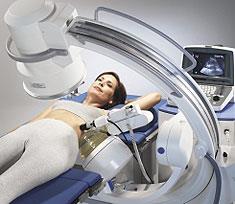
- We may give you an injection of antibiotics before the procedure, after you have been checked for any allergies
- We normally give you a painkilling injection or tablet before the treatment
- You will be awake throughout the procedure although we sometimes use a sedative to make you sleepy
- Children undergoing lithotripsy need to have a general anaesthetic
- We position you on the treatment couch with either gel or water applied to your skin to ensure good contact with the shockwave generator
- The machine fires pulsed shockwaves once the stone has been pinpointed using X-rays or ultrasound (pictured)
- You should try and lie as still as possible during the treatment
- Each shockwave creates a sensation like being flicked in the back with an elastic band; sometimes, you may feel a deeper discomfort in your kidney
- We can give you additional painkiller or sedation if the treatment proves very painful for you
- We often pause during the treatment to check the stone position and adjust the targeting, if necessary
- Treatment normally lasts 30 to 60 minutes, depending on the size of your stone
- You will be able to go home within a couple of hours but you should not attempt to drive yourself home
Are there any after-effects?
The possible after-effects and your risk of getting them are shown below. Some are self-limiting or reversible, but others are not. We have not listed very rare after-effects (occurring in less than 1 in 250 patients) individually. The impact of these after-effects can vary a lot from patient to patient; you should ask your surgeon’s advice about the risks and their impact on you as an individual:
| After-effect | Risk |
|---|---|
| Blood in your urine (which can last several days) |
 Between 1 in 2 & 1 in 10 patients Between 1 in 2 & 1 in 10 patients |
| Pain in your kidney as small fragments of stone pass |
Between 1 in 2 & 1 in 10 patients |
| Need for further lithotripsy treatment to clear any stone(s) remaining |
Between 1 in 2 & 1 in 10 patients |
| Failure to break the stone (which may need an alternative treatment) |
Between 1 in 2 & 1 in 10 patients |
| Recurrence of stones in the future |
Between 1 in 2 & 1 in 10 patients |
| Infection on your urinary tract |
 Between 1 in 10 & 1 in 50 patients Between 1 in 10 & 1 in 50 patients |
| Bruising or blistering of the skin at the site of shockwave entry or exit |
Between 1 in 10 & 1 in 50 patients |
| Some fragments may get stuck in your ureter (between the kidney & bladder) requiring surgical removal |
Between 1 in 10 & 1 in 50 patients |
| Severe infection requiring injected antibiotics or drainage of the kidney with a small tube (nephrostomy) |
 Between 1 in 50 & 1 in 250 patients Between 1 in 50 & 1 in 250 patients |
| Kidney damage with severe bruising |
Between 1 in 50 & 1 in 250 patients |
| Inadvertent damage to the pancreas or lungs |
Between 1 in 50 & 1 in 250 patients |
What is my risk of a hospital-acquired infection?
Your risk of getting an infection in hospital is between 4 & 6%; this includes getting MRSA or a Clostridium difficile bowel infection. This figure is higher if you are in a “high-risk” group of patients such as patients who have had:
- Long-term drainage tubes (e.g. catheters);
- Bladder removal;
- Long hospital stays; or
- Multiple hospital admissions.
What can I expect when I get home?
- You will be given advice about your recovery at home but, generally, you should be able to go back to your regular activity the next day
- You will be given a copy of your discharge summary and a copy will also be sent to your GP
- Antibiotics, and any other tablets you may need, will be dispensed from the hospital pharmacy; you must complete the course of antibiotics
- You should drink twice as much as you would normally, to flush your system through and reduce the risk of bleeding or infection
- You may see blood in your urine for several days
- You may re-start your aspirin or blood-thinning drugs when your urine contains no visible blood
- You should take anti-inflammatory painkillers (e.g. diclofenac, ibuprofen) as required, but not if you have asthma, a stomach ulcer or sensitivity to aspirin
- Any bruising or blistering on your skin after the procedure usually disappears within 7 days; any discomfort can be helped by soothing skin creams
- If you experience a high temperature, severe pain on passing urine, an inability to pass urine or increasing bleeding, you should contact your doctor immediately
- If your pain is severe and does not settle, you should contact your urology unit, attend your local Accident & Emergency Department or contact your GP
- We will tell you what follow-up arrangements are needed after your treatment
- If you have a ureteric stent, you may receive an appointment for removal of the stent under local anaesthetic
General information about surgical procedures
Before your procedure
Please tell a member of the medical team if you have:
- An implanted foreign body (stent, joint replacement, pacemaker, heart valve, blood vessel graft);
- A regular prescription for a blood thinning agent (e.g. warfarin, aspirin, clopidogrel, rivaroxaban, dabigatran);
- A present or previous MRSA infection; or
- A high risk of variant-CJD (e.g. if you have had a corneal transplant, a neurosurgical dural transplant or human growth hormone treatment).
Questions you may wish to ask
If you wish to learn more about what will happen, you can find a list of suggested questions called “Having An Operation” on the website of the Royal College of Surgeons of England. You may also wish to ask your surgeon for his/her personal results and experience with this procedure.
Before you go home
We will tell you how the procedure went and you should:
- Make sure you understand what has been done;
- Ask the surgeon if everything went as planned;
- Let the staff know if you have any discomfort;
- Ask what you can (and cannot) do at home;
- Make sure you know what happens next; and
- Ask when you can return to normal activities.
We will give you advice about what to look out for when you get home. Your surgeon or nurse will also give you details of who to contact, and how to contact them, in the event of problems.
Smoking and surgery
Ideally, we would prefer you to stop smoking before any procedure. Smoking can worsen some urological conditions and makes complications more likely after surgery. For advice on stopping, you can:
- Contact your GP;
- Access your local NHS Smoking Help Online; or
- Ring the free NHS Smoking Helpline on 0300 123 1044.
Driving after surgery
It is your responsibility to make sure you are fit to drive after any surgical procedure. You only need to contact the DVLA if your ability to drive is likely to be affected for more than three months. If it is, you should check with your insurance company before driving again.