
Suprapubic versus urethral catheter?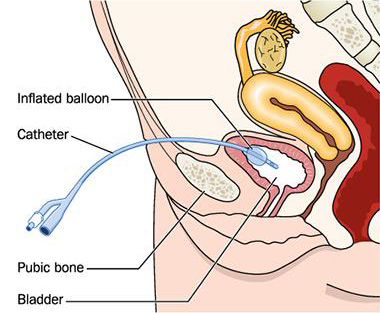
If you are unable to empty your bladder normally, you may need to have a catheter put in. This is a small tube, made out of latex or silicone, that stays in the bladder and allows urine to drain out. The catheter has a balloon at one end which we fill with fluid to stop the catheter falling out. We normally change the catheter every three months.
We usually put a catheter in through your urethra (waterpipe); this is called a urethral catheter. Sometimes, we put it in through the lower part of your abdomen (tummy); this is called a suprapubic catheter.
What problems could I have with a catheter?
All catheters (urethral and suprapubic) can have problems. These include:
- the catheter falling out;
- the catheter may get blocked and stop draining;
- the catheter can cause painful bladder spasms;
- urine leakage around the catheter;
- recurrent urine infections; and
- bladder stones or debris in your urine.
Are there any advantages to a suprapubic catheter?
- patients often find them more comfortable and easier to look after;
- they are usually easier to change;
- they might be less likely to get blocked;
- sometimes, a urethral catheter can cause damage to the urethra; this can be avoided with a suprapubic catheter; and
- sex can be uncomfortable with a urethral catheter.
What are the disadvantages?
- you need to have an operation to put the suprapubic catheter in. There is a separate information sheet about this procedure and its possible after-effects. You do not need an operation to have the catheter changed
- you may get some discharge around the catheter on your abdomen (tummy); this is normal and does not need any treatment
- you may leak urine through your urethra (waterpipe)
What could I have instead of a suprapubic catheter?
Instead of having a permanent suprapubic, you may be able to have one of the following:
- incontinence pads
- intermittent self-catheterisation
- an urethral catheter (permanent)
How are suprapubic catheters put in?
Suprapubic catheters are usually put in under a general anaesthetic (with you asleep). You can also have this operation under a spinal anaesthetic (an injection in your back which leaves you awake but you feel nothing below your waist). You can get information about suprapubic catheter insertion from the BAUS website.
How are suprapubic catheters changed?
Your catheter will usually need changing every three months by your district nurse. This can be done quickly and simply in your own home.
What do I do if the catheter falls out?
If your catheter falls out, it must be put back in as soon as possible. This is easy to do, provided it is done quickly. You should contact your doctor, district nurse or local A&E if this happens.
If your catheter cannot be put back, the hole in your abdomen (tummy) will close up and you may need further surgery under an anaesthetic to replace it.