
What does this procedure involve?
The artificial urinary sphincter (AUS) is a device that is put inside your body to help control urinary leakage in men with moderate to severe stress urinary incontinence.
The device is completely concealed, so urinary control is discreet and there are no external parts. The device consists of a cuff that surrounds your urethra (waterpipe), a pump that sits in the scrotum and a pressure-regulating balloon that sits in your abdomen.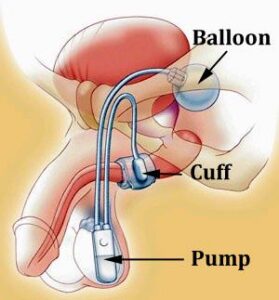
When the cuff is inflated, urine leakage is limited; the pump must be pushed to deflate the cuff and allow you to pass urine. The cuff will then re-inflate automatically, after five minutes, to stop any further urine flow.
After the device has been put in, most men are dry with only minor leaks or dribbles of urine during strenuous exercise or exertion. Most men use one pad (or less) each day to manage these minor leaks.
We usually place the cuff around the bulbar urethra but it sometimes needs to be implanted at the bladder neck.
What are the alternatives?
- Conservative management – continence aids, such as pads or other devices to contain your urinary leakage
- Pelvic floor exercises – muscle training to strengthen your pelvic floor and reduce urinary leakage; often recommended as a first-line treatment in male stress urinary incontinence
- Insertion of a male sling – a mesh “sling” implanted to reposition and support your urethra and to restore normal bladder control; requires no patient interaction and is completely undetectable to others
- Urethral or suprapubic catheter – putting a catheter into your bladder to drain urine directly into a bag. A catheter can be put in through your waterpipe (a urethral catheter) or directly through your abdominal wall (a suprapubic catheter). Catheters tend to be used in men who are considered unsuitable for surgical treatment. They may cause urinary tract infections, bladder stones and other problems.
- Urinary diversion – in some men, the best way of managing incontinence may be a urinary diversion. This is a major operation where your ureters (tubes that carry urine from the kidneys to the bladder) are divided and a section of isolated small bowel is joined to the ureters, on the abdominal (tummy) wall, as a stoma. Your urine is collected in a bag on the surface of your abdomen.
What happens on the day of the procedure?
Your urologist (or a member of their team) will briefly review your history and medications, and will discuss the surgery again with you to confirm your consent.
An anaesthetist will see you to discuss the options of a general anaesthetic or spinal anaesthetic. The anaesthetist will also discuss pain relief after the procedure with you.
We may provide you with a pair of TED stockings to wear, and give you an injection to thin your blood. These help to prevent blood clots from developing and passing into your lungs. Your medical team will decide whether you need to continue these after you go home.
Details of the procedure
- we usually carry out the procedure under a general anaesthetic
- you may be given an injection of antibiotics before the procedure, after you have been checked carefully for any allergies
- we make an incision in your perineum (the area between the back of the scrotum and the anus); if the cuff is being inserted at the bladder neck, the incision will be in your lower abdomen (tummy)
- we mobilise your urethra and position the cuff around your water pipe
- we make a further small incision in the abdomen to implant the balloon and to pass the control pump down into the scrotum
- we connect the components with tubing which is filled with sterile fluid
- we close your skin incisions with dissolvable stitches
- we place a catheter in your bladder during the operation; this may be removed before you wake up or on the following day (before your discharge from hospital)
- we “deactivate” the device at the end of the operation to allow your tissues to heal
- you will be incontinent during this early period and will need to continue using your pre-operative continence aids
- we activate the pump (as a simple outpatient procedure) at around six weeks after insertion of the AUS
Are there any after-effects?
The possible after-effects and your risk of getting them are shown below. Some are self-limiting or reversible, but others are not. We have not listed very rare after-effects (occurring in less than 1 in 250 patients) individually. The impact of these after-effects can vary a lot from patient to patient; you should ask your surgeon’s advice about the risks and their impact on you as an individual:
| After-effect | Risk |
|---|---|
| Swelling and bruising of the wound site, perineum and scrotum |
 Between 1 in 2 & 1 in 10 patients Between 1 in 2 & 1 in 10 patients |
| Chronic (long-term) discomfort in your lower abdomen, perineum or scrotum |
Between 1 in 2 & 1 in 10 patients |
| Wound or urinary tract infection requiring antibiotic treatment |
 Between 1 in 10 & 1 in 50 patients Between 1 in 10 & 1 in 50 patients |
| Infection or erosion of the device requiring its removal |
Between 1 in 10 & 1 in 50 patients |
| Mechanical failure of the device requiring a further procedure for revision |
Between 1 in 10 & 1 in 50 patients |
| Failure to control your continence |
Between 1 in 10 & 1 in 50 patients |
| New onset of urge incontinence |
Between 1 in 10 & 1 in 50 patients |
| Urethral shrinkage (atrophy) leading to recurrent leakage of urine, requiring further surgery |
Between 1 in 10 & 1 in 50 patients |
| Anaesthetic or cardiovascular problems possibly requiring intensive care (including chest infection, pulmonary embolus, stroke, deep vein thrombosis, heart attack and death) |
 Between 1 in 50 & 1 in 250 patients (your anaesthetist can estimate your individual risk) Between 1 in 50 & 1 in 250 patients (your anaesthetist can estimate your individual risk) |
What information will I need to take home?
You should be given documentation, usually in the form of a sphincter card, after implantation showing what device has been implanted. You must show this to any clinician involved in your care, particularly if you need catheterisation at a later date. Inserting a catheter can be potentially dangerous after AUS insertion and can cause permanent damage if not done correctly.
The sphincter can be decompressed or deactivated using the pump in your scrotum. However, unless the clinician is familiar with how to do this, a urologist must be called for before any attempt at catheterisation is made.
What is my risk of a hospital-acquired infection?
Your risk of getting an infection in hospital is between 4 & 6%; this includes getting MRSA or a Clostridium difficile bowel infection. Individual hospitals may have different rates, and the medical staff can tell you the risk for your hospital. You have a higher risk if you have had:
- long-term drainage tubes (e.g. catheters);
- long hospital stays; or
- multiple hospital admissions.
What can I expect when I get home?
- you will be given advice about your recovery at home
- you will be shown how to avoid activating your device and what to do if you cannot pass urine
- you will be given a copy of your discharge summary and a copy will also be sent to your GP
- any antibiotics or other tablets you may need will be arranged & dispensed from the hospital pharmacy
- a follow-up appointment will be arranged for device activation
If you have abdominal, groin or perineal surgery at any time in the future, you MUST tell any surgeon that you have an AUS. Failure to do so may put the device at risk of damage during any later surgery.
General information about surgical procedures
Before your procedure
Please tell a member of the medical team if you have:
- an implanted foreign body (stent, joint replacement, pacemaker, heart valve, blood vessel graft);
- a regular prescription for a blood thinning agent (e.g. warfarin, aspirin, clopidogrel, rivaroxaban, dabigatran);
- a present or previous MRSA infection; or
- a high risk of variant-CJD (e.g. if you have had a corneal transplant, a neurosurgical dural transplant or human growth hormone treatment).
Questions you may wish to ask
If you wish to learn more about what will happen, you can find a list of suggested questions called “Having An Operation” on the website of the Royal College of Surgeons of England. You may also wish to ask your surgeon for his/her personal results and experience with this procedure.
Before you go home
We will tell you how the procedure went and you should:
- make sure you understand what has been done;
- ask the surgeon if everything went as planned;
- let the staff know if you have any discomfort;
- ask what you can (and cannot) do at home;
- make sure you know what happens next; and
- ask when you can return to normal activities.
We will give you advice about what to look out for when you get home. Your surgeon or nurse will also give you details of who to contact, and how to contact them, in the event of problems.
Smoking and surgery
Ideally, we would prefer you to stop smoking before any procedure. Smoking can worsen some urological conditions and makes complications more likely after surgery. For advice on stopping, you can:
- contact your GP;
- access your local NHS Smoking Help Online; or
- ring the free NHS Smoking Helpline on 0300 123 1044.
Driving after surgery
It is your responsibility to make sure you are fit to drive after any surgical procedure. You only need to contact the DVLA if your ability to drive is likely to be affected for more than three months. If it is, you should check with your insurance company before driving again.