
What does this procedure involve?
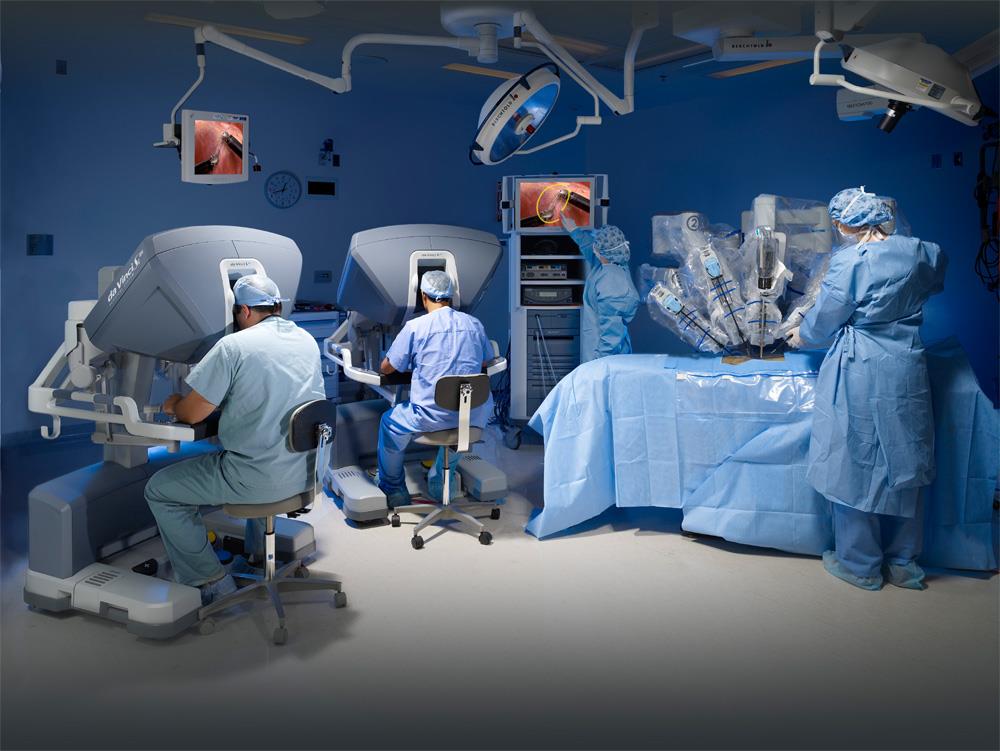
This involves very precise removal of the whole prostate gland, seminal vesicles and, sometimes, the draining lymph glands, as well as tying off the vasa deferentia (sperm-carrying tubes). It is performed through several small puncture (keyhole) incisions in your lower abdomen, using robotic instruments.
Our aims in men with cancer confined to the prostate gland are:
- To remove the cancer
- To achieve a clear margin away from the tumour
- To drop the PSA blood level below 0.1 ng per ml
- To reduce the need for any further treatment (e.g. radiotherapy or hormone treatment)
- To preserve your continence
- If possible and appropriate, to preserve the erection nerves to your penis
Robotic surgery uses sophisticated mini-instruments which are totally under the control of the surgeon. The robot mimics and assists the surgeon’s movements; it does not do the operation. This technique is now widely used because of its high degree of surgical accuracy, and because recovery is much faster than it is for open surgery.
Your surgeon will try to preserve the muscle fibres and nerves that control continence. If you still leak some urine after a year (as 1 in 20 to 1 in 33 patients do), this can be corrected by another procedure such as an artificial urinary sphincter or a male sling.
The erection nerves lie very close to your prostate, forming a cobweb of delicate strands over its surface. If your erections were normal before the procedure, it is usually possible to preserve them (called nerve-sparing prostatectomy). It can be very successful in maintaining your erections after the procedure although they may take some time to recover. We can only preserve these nerves if the cancer has not reached the layer where they lie.
Your team will explain how you can enjoy a healthy sex life after surgery, even if the nerves do not recover or need to be removed.
What are the alternatives for organ-confined cancer?
- Active surveillance – no active treatment but careful monitoring of your PSA levels with repeated biopsies and further intervention only if there is definite evidence of cancer progression
- Open radical retropubic prostatectomy – performed through an incision in your lower abdomen (tummy)
- External beam radiotherapy – giving an intensive course of external irradiation to your prostate gland
- Permanent seed brachytherapy – implanting radio-active seeds under ultrasound control into your prostate gland
- High intensity focused ultrasound (HIFU) – only available in a few specialist centres and, because we do not have long-term results, needs to be given as part of a clinical trial
- Cryotherapy – freezing & thawing the prostate with fine needles passed into the gland; only available in a few specialist centres and, because we do not have long-term results, needs to be given as part of a clinical trial
Deciding which treatment to have is not something you will do alone and may depend on the level of expertise available at your hospital. If you need further information, please contact your specialist nurse, surgical care practitioner or urologist.
You should be aware that there is a small chance (one in 100 – or 1%) that we might have to convert a laparoscopic (“keyhole”) procedure to open surgery. Because of this, we are not able to proceed with a robotic (keyhole) procedure if you are not willing to have open surgery under any circumstances.
What happens on the day of the procedure?
Your urologist (or a member of their team) will briefly review your history and medications, and will discuss the surgery again with you to confirm your consent.
An anaesthetist will see you to discuss the options of a general anaesthetic or spinal anaesthetic. The anaesthetist will also discuss pain relief after the procedure with you.
We may provide you with a pair of TED stockings to wear, and we may give you a heparin injection to thin your blood. These help to prevent blood clots from developing and passing into your lungs. After discharge from hospital, most patients are prescribed heparin injections for 28 days, unless contraindicated.
A few patients may need an enema before surgery to ensure that your bowel is clear.
Details of the procedure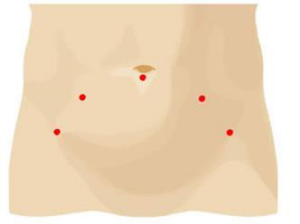
- We normally perform the procedure under a general anaesthetic
- We will give you an injection of antibiotics before the procedure, after carefully checking for any allergies
- We make five or six keyhole incisions (cuts) in your abdomen (tummy) that allow the robotic instruments to be put in
- These instruments allow the surgeon to free your prostate from the bladder and urethra (waterpipe) so it can be removed, whilst sparing the muscles and nerves that control continence and trying to preserve your erection nerves
- We then re-join your urethra to your bladder using absorbable stitches
- We use local anaesthetic to numb the keyhole incisions and minimise your discomfort when you wake up
- All the keyhole incisions are closed with absorbable stitches
- We put a catheter in your bladder to drain the urine while the new join between the bladder and urethra heals
- The procedure usually takes two to three hours to perform
After the procedure, you often get some bruising and swelling around the keyhole incisions together with some swelling or puffiness in your scrotum. You may also get some facial puffiness for a day or two (because you lie slightly “head down” during the surgery). You may feel some shoulder pain and bloating until your bowel starts working again (normally after 24 hours).
Most patients can go home after a day or two.
Are there any after-effects?
The possible after-effects and your risk of getting them are shown below. Some are self-limiting or reversible, but others are not. We have not listed very rare after-effects (occurring in less than 1 in 250 patients) individually. The impact of these after-effects can vary a lot from patient to patient; you should ask your surgeon’s advice about the risks and their impact on you as an individual:
| After-effect | Risk |
|---|---|
| No semen is produced during an orgasm, effectively making you infertile |
 All patients All patients |
| A high chance of erectile dysfunction (impotence) if a nerve-sparing operation is not possible or nerve damage is unavoidable, together with some shortening of your penis |
 Almost all patients after catheter removal (80 to 85%) Almost all patients after catheter removal (80 to 85%) |
| Mild urinary incontinence which may persist for more than a year and require safety pads (but not corrective surgery) |
 Between 1 in 5 & 1 in 10 patients (10 to 20%) Between 1 in 5 & 1 in 10 patients (10 to 20%) |
| Severe urinary incontinence which may be temporary and require pads, but may need further surgery if it lasts for more than a year (e.g. an artificial urinary sphincter or a synthetic male sling) |
 Between 1 in 20 & 1 in 33 patients (3 to 5%) Between 1 in 20 & 1 in 33 patients (3 to 5%) |
| Pathology tests that show cancer outside or at the margin of the prostate (positive margins) requiring observation & possible further treatment |
Between 1 in 10 & 1 in 50 patients |
| Further treatment with hormones, radiotherapy or chemotherapy may be needed at a later date if your PSA blood test still shows that cancer is present |
Between 1 in 10 & 1 in 50 patients |
| Leakage of urine from the new joint between bladder and urethra, delaying discharge or needing longer catheter time |
Between 1 in 10 & 1 in 50 patients |
| Bleeding requiring transfusion or further surgery |
Between 1 in 10 & 1 in 50 patients |
| Pain, infection or hernia in any of the port incisions requiring further treatment |
Between 1 in 10 & 1 in 50 patients |
| Lymph fluid collection (if the pelvic lymph nodes were removed or biopsied during surgery) |
Between 1 in 10 & 1 in 50 patients |
| Anaesthetic or cardiovascular problems possibly requiring intensive care admission (including chest infection, pulmonary embolus, stroke, deep vein thrombosis, compartment syndrome, heart attack) |
 Between 1 in 50 & 1 in 250 patients (your anaesthetist can estimate your individual risk) Between 1 in 50 & 1 in 250 patients (your anaesthetist can estimate your individual risk) |
| Need for conversion to open surgery due to operative difficulty or failure to progress |
1 in 100 patients (1%) |
| Eye problems, or numbness & weakness due to nerve compression caused by your “head-down” position during surgery |
Between 1 in 50 & 1 in 250 patients |
| Recognised or unrecognised injury to the bowel (small or large bowel) requiring temporary colostomy to allow healing |
Between 1 in 200 & 1 in 250 patients |
What is my risk of a hospital-acquired infection?
Your risk of getting an infection in hospital is between 4 & 6%; this includes getting MRSA or a Clostridium difficile bowel infection. This figure is higher if you are in a “high-risk” group of patients such as patients who have had:
- Long-term drainage tubes (e.g. catheters)
- Long hospital stays
- Multiple hospital admissions
What can I expect when I get home?
- You will get some swelling and bruising of the incisions which may last several days
- It may be several days before you have your bowels open
- You are likely to be discharged with a catheter in your bladder
- If you do have a catheter, we will show you how to manage it at home
- You will be given advice about your recovery at home
- You will be given a copy of your discharge summary and a copy will also be sent to your GP
- Any antibiotics or other tablets you may need will be arranged and dispensed from the hospital pharmacy
- A follow-up appointment will be made for you to have your dressings and your catheter removed
- Once your catheter has been removed, you should start doing pelvic floor exercises
- Do not worry if you leak some urine when your catheter comes out; almost everyone has a period of bladder recovery when they will need to wear protective pads
- We will discuss the microscopic analysis of your prostate in a multi-disciplinary team (MDT) meeting
- We will arrange for you to have your first PSA check six to eight weeks after the procedure
General information about surgical procedures
Before your procedure
Please tell a member of the medical team if you have:
- An implanted foreign body (stent, joint replacement, pacemaker, heart valve, blood vessel graft)
- A regular prescription for a blood thinning agent (e.g. warfarin, aspirin, clopidogrel, rivaroxaban, dabigatran)
- A present or previous MRSA infection
- A high risk of variant-CJD (e.g. if you have had a corneal transplant, a neurosurgical dural transplant or human growth hormone treatment)
Questions you may wish to ask
If you wish to learn more about what will happen, you can find a list of suggested questions called “Having An Operation” on the website of the Royal College of Surgeons of England. You may also wish to ask your surgeon for his/her personal results and experience with this procedure.
Before you go home
We will tell you how the procedure went and you should:
- Make sure you understand what has been done
- Ask the surgeon if everything went as planned
- Let the staff know if you have any discomfort
- Ask what you can (and cannot) do at home
- Make sure you know what happens next
- Ask when you can return to normal activities
We will give you advice about what to look out for when you get home. Your surgeon or nurse will also give you details of who to contact, and how to contact them, in the event of problems.
Smoking and surgery
Ideally, we would prefer you to stop smoking before any procedure. Smoking can worsen some urological conditions and makes complications more likely after surgery. For advice on stopping, you can:
- Contact your GP
- Access your local NHS Smoking Help Online
- Ring the Smoke-Free National Helpline on 0300 123 1044
Driving after surgery
It is your responsibility to make sure you are fit to drive after any surgical procedure. You only need to contact the DVLA if your ability to drive is likely to be affected for more than three months. If it is, you should check with your insurance company before driving again.