
What does this procedure involve?
Penile prostheses (implants) are designed to provide enough rigidity to your penis for sexual activity. The procedure does not affect your desire to have sex (your libido), penile sensation or your sensation of orgasm (climax).
The implants can be felt but lie completely within your body. They are normally used for erectile dysfunction (impotence) but may also be used for:
- Priapism – prolonged erections resulting in death of muscle tissue in the penis, especially when the condition has failed to respond to other measures;
- Peyronie’s disease – to help straighten severe bending of the penis on erection where simple straightening might result in erectile dysfunction, where there is significant loss of erect penile length or where erectile function is poor; or
- Incontinence – to make your penis protrude enough to attach a continence sheath for control of your urinary leakage.
What types of penile implants are available?
Before the procedure, you will have a full counselling session, with your surgeon and specialist nurse, regarding the different types of implant, and you will be shown how they look and work. Typically, an implant lasts 10 to 15 years, after which it may need to be exchanged for a new one.
There are three basic types of implant:
- malleable – this consists of two flexible rods that produce permanent rigidity but are “bendy” so they can be concealed. They are quick and easy to insert, rarely develop mechanical problems and are especially useful in men with complex medical problems or poor dexterity (hand function);
- three-piece inflatable – this consists of two paired cylinders placed in the penis, a pump in the scrotum and a fluid-filled reservoir in the abdomen. The pump is activated by hand to fill the cylinders with fluid from the reservoir: a release button reverses the process to restore a flaccid (soft) penis. Because they have many parts, they take longer to put in and have a higher, but still very small, risk of mechanical problems which may require surgical repair; and
- two-piece inflatable – this consists of two pre-filled cylinders which require a scrotal pump but have no fluid reservoir. They are useful if you have had pelvic or abdominal surgery which makes reservoir insertion difficult. They do not become as flaccid (floppy) when deflated as three-piece devices.
The procedure should be regarded as “end-stage” irreversible surgery. You should discuss all alternative treatments with your urologist before opting for penile prostheses.
What will a penile implant do and not do?
A penile implant will make your penis hard enough for sexual activity. You will be able to have an erect (hard) penis:
- whenever you wish;
- for as long as you wish;
- and as often as you wish.
A penile implant will NOT increase the size and width of your penis in the same way a natural erection would. In addition, the head of your penis may not become as rigid as it would with a natural erection.
What are the alternatives?
Patients may already have been tried on multiple different treatments, including:
- Psychosexual counselling
- Tablets by mouth – drugs (e.g. sildenafil, tadalafil, vardenafil or avanafil)
- Vacuum erection assistance devices – an external appliance that sucks blood into your penis and keeps it rigid (hard) by using a constriction ring
- Medicated urethral system for erection – using a small pellet placed in your urethra (waterpipe) with a plastic applicator
- Penile cream – applied directly to the head of your penis
- Penile injections – injected directly into the side of your penis
In Peyronie’s disease, we may consider penile prostheses if there is associated poor erectile function or severe curvature where conventional surgery has a high chance of resulting in erectile dysfunction or an unacceptable loss of erect penis length.
In acute ischaemic priapism, we may consider a penile prosthesis if the priapism has been present for more than two or three days and this has failed to respond to other measures (aspiration, medication and shunt surgery).
What happens on the day of the procedure?
Your urologist (or a member of their team) will briefly review your history and medications, and will discuss the surgery again with you to confirm your consent.
An anaesthetist will see you to discuss the options of a general anaesthetic or spinal anaesthetic. The anaesthetist will also discuss pain relief after the procedure with you.
We usually provide you with a pair of TED stockings to wear and, after the operation, give you a heparin injection. These help to prevent blood clots from developing and passing into your lungs. Your medical team will decide whether you need to continue wearing the stockings after you go home.
Details of the operation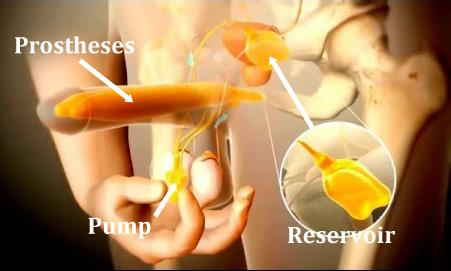
- we will shave and clean the area with antiseptic for five to 10 minutes to minimise the risk of infection
- we usually carry out the procedure under a general anaesthetic or, occasionally, under a spinal anaesthetic (where you are awake or sedated, but unable to feel anything from the waist down)
- we will give you an injection of antibiotics before the procedure, after you have been checked carefully for any allergies
- we usually make a small cut either just below the junction between your penis & scrotum, or just above the junction of your penis and your lower abdomen (tummy). We are able to complete most of the procedure through this single incision but, occasionally, we need to make a second incision in your abdomen to position the reservoir
- we break down the tissue inside the erectile cylinders of the penis (corpora cavernosa) and measure the space produced so that the largest appropriate size of implant can be put in
- we create a space in the scrotum for the pump (if an inflatable device is being used), usually between your testicles, at the front and lowest part of your scrotum (so it can be found easily)
- if a fluid reservoir is needed (see above), we place this either alongside the bladder or beneath the muscle in your lower abdomen through a separate incision
- the inflatable devices are filled with fluid, air is expelled from the cylinders & connecting tubing, and inflation is tested whilst you are asleep
- you will probably have a small drain left in the wound and you may have a catheter overnight
- we normally wrap the penis in a firm dressing to reduce swelling and bruising
On the day after your operation, any catheter and drain will usually be removed. Your dressing can be removed by you two days after the procedure. If you have an inflatable device, we will deflate this before you go home. You may find the first deflation quite uncomfortable but do not be put off by this.
Are there any after-effects?
The possible after-effects and your risk of getting them are shown below. Some are self-limiting or reversible, but others are not. We have not listed very rare after-effects (occurring in less than 1 in 250 patients) individually. The impact of these after-effects can vary a lot from patient to patient; you should ask your surgeon’s advice about the risks and their impact on you as an individual:
| After-effect | Risk |
|---|---|
| Bruising and swelling of the penis |
 Almost all patients Almost all patients |
| Infection of the device when implanted for revision, priapism/fibrosis or where the procedure was complex (see below for infection risk in “first-time” surgery) |
 Between 1 in 10 & 1 in 16 patients (from 6 to 10%) Between 1 in 10 & 1 in 16 patients (from 6 to 10%) |
| Malfunction/mechanical failure of inflatable implants within 10 years (which can result in uncontrolled self-inflation & require further surgery) |
 1 in 20 patients (5%) 1 in 20 patients (5%) |
| Erosion of the device requiring further surgery |
Between 1 in 20 & 1 in 50 patients (less than 5%) |
| Floppiness or “drooping” of the glans (head of the penis) down towards your legs |
Between 1 in 10 & 1 in 50 patients |
| Infection of the device (following first-time implantation) |
Between 1 in 50 & 1 in 100 patients (from 1 to 2%) |
| Inadvertent injury to your bladder, bowel or adjacent blood vessels, or perforation of the corpora during insertion (which may prevent implantation) |
 Between 1 in 50 & 1 in 250 patients Between 1 in 50 & 1 in 250 patients |
| Anaesthetic or cardiovascular problems possibly requiring intensive care (including chest infection, pulmonary embolus, stroke, deep vein thrombosis, heart attack and death) |
Between 1 in 50 & 1 in 250 patients (your anaesthetist can estimate your individual risk) |
What is my risk of a hospital-acquired infection?
Your risk of getting an infection in hospital is between 4 & 6%; this includes getting MRSA or a Clostridium difficile bowel infection. This figure is higher if you are in a “high-risk” group of patients such as patients who have had:
- long-term drainage tubes (e.g. catheters);
- bladder removal;
- long hospital stays; or
- multiple hospital admissions.
What can I expect when I get home?
- you will be given advice about your recovery at home before you leave hospital
- you will have some swelling and discomfort for a couple of weeks after the procedure
- we will give you a copy of your discharge summary, and a copy will also be sent to your GP
- we will give you a course of antibiotics to take home; any other tablets you may need will be arranged & dispensed from the hospital pharmacy
- we will arrange an outpatient appointment for you two to three weeks after the procedure so you can learn how to start bending or inflating the device
- you should avoid all sexual activity until four weeks after your operation
If you have abdominal, groin or perineal surgery at any future time, you MUST tell any surgeon that you have inflatable penile implants. Failure to do so may put parts of the implant at risk of damage during any later surgery.
General information about surgical procedures
Before your procedure
Please tell a member of the medical team if you have:
- an implanted foreign body (stent, joint replacement, pacemaker, heart valve, blood vessel graft);
- a regular prescription for a blood thinning agent (e.g. warfarin, aspirin, clopidogrel, rivaroxaban, dabigatran);
- a present or previous MRSA infection; or
- a high risk of variant-CJD (e.g. if you have had a corneal transplant, a neurosurgical dural transplant or human growth hormone treatment).
Questions you may wish to ask
If you wish to learn more about what will happen, you can find a list of suggested questions called “Having An Operation” on the website of the Royal College of Surgeons of England. You may also wish to ask your surgeon for his/her personal results and experience with this procedure.
This is a procedure that is carried out by a small number of surgeons in a limited number of centres.
Before you go home
We will tell you how the procedure went and you should:
- make sure you understand what has been done;
- ask the surgeon if everything went as planned;
- let the staff know if you have any discomfort;
- ask what you can (and cannot) do at home;
- make sure you know what happens next; and
- ask when you can return to normal activities.
We will give you advice about what to look out for when you get home, and any action you may need take to help your recovery. Your surgeon or nurse will also give you details of who to contact, and how to contact them, in the event of problems.
Smoking and surgery
Ideally, we would prefer you to stop smoking before any procedure. Smoking can worsen some urological conditions and makes complications more likely after surgery. For advice on stopping, you can:
- contact your GP;
- access your local NHS Smoking Help Online; or
- ring the free NHS Smoking Helpline on 0300 123 1044.
Driving after surgery
It is your responsibility to make sure you are fit to drive after any surgical procedure. You only need to contact the DVLA if your ability to drive is likely to be affected for more than three months. If it is, you should check with your insurance company before driving again.