
What does this procedure involve?
This is an operation to treat stress incontinence (leakage of urine when you exercise, sneeze or strain). The operation involves injecting a bulking agent into the wall of your urethra (waterpipe) using a small telescope to treat symptoms of stress urinary incontinence (SUI). The bulking agent helps the urethra to make a watertight seal and to prevent urine leaking from your bladder.
There are several different bulking agents in use in the UK. Your surgeon will be able to give you more information about the bulking agents they use.
What are the alternatives?
Stress incontinence can be treated without surgery. We recommend that all patients try non-surgical treatment before having an operation, because it avoids the risks of side-effects or complications of surgery.
- Incontinence pads – if your symptoms are not a bother, you may choose to do nothing and use pads for urine leakage
- Pelvic floor exercises – supervised by a continence advisor or physiotherapist can improve stress incontinence in 70% of women
- Weight loss and giving up smoking can also help
- Continence pessaries – temporarily placed inside the vagina, are used to treat incontinence that occurs only during exercise
There are a number of operations used to treat stress incontinence. Each one has advantages and disadvantages, and different operations may be better for different people. You should discuss these with your surgeon before making a decision:
- Mid-urethral tape operations¹ (e.g. TVT or TOT) – using a synthetic mesh tape to support your urethra from below
- Autologous sling procedure – using a piece of strong tissue from your abdominal (tummy) wall to support your urethra from below
- Colposuspension – an open operation which lifts the tissues around your bladder neck on to the back of your pelvis
- Artificial sphincter operation – an implant that squeezes the urethra
For further information about the options available to treat stress urinary incontinence, see the BAUS leaflet on the comparison of treatment options for stress urinary incontinence in women and the NICE guideline NG123.
¹ Mid-urethral tape operations are currently “paused” on the recommendation of the July 2020 Cumberlege report
What happens on the day of the procedure?
You will be seen by the surgeon and the anaesthetist who will go through the plans for your operation with you.
We may provide you with a pair of TED stockings to wear, and we may give you a heparin injection to thin your blood. These help to prevent blood clots from developing and passing into your lungs. Your medical team will decide whether you need to continue these after you go home.
Details of the procedure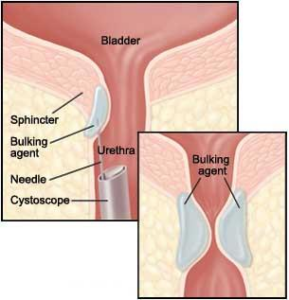
- we can use a full general anaesthetic (where you are asleep), a spinal anaesthetic or local anaesthetic (for both of which you are awake)
- we put a telescope into your bladder through your urethra to inspect your urethra and bladder
- we inject a bulking agent into the wall of your urethra to raise cushions of tissue which help keep it closed (pictured above)
- most patients go home on the same day as their procedure
How effective is the procedure in curing stress urinary incontinence?
About 70% (seven out of 10) women will be significantly improved or completely dry after a urethral bulking procedure. Some women, however, start to leak urine again at a later stage and may need either further injections or another type of operation. In the longer term, 50% (half) of women treated by urethral bulking will have a successful outcome.
Are there any after-effects?
The possible after-effects and your risk of getting them are shown below. Some are self-limiting or reversible, but others are not. We have not listed very rare after-effects (occurring in less than 1 in 250 patients) individually. The impact of these after-effects can vary a lot from patient to patient; you should ask your surgeon’s advice about the risks and their impact on you as an individual:
| After-effect | Risk |
|---|---|
| Mild burning on passing urine for a short time after the procedure |
 Almost all patients Almost all patients |
| Mild bleeding in your urine for a short time after the procedure |
Almost all patients |
| Failure to improve your urinary incontinence significantly requiring a further procedure at a later stage |
 Between 1 in 2 & 1 in 5 patients (20–50%) Between 1 in 2 & 1 in 5 patients (20–50%) |
| Recurrence of your incontinence within 12 months and the possible need for further injections |
Around 1 in 5 patients (20%) |
| Slowing of your urinary flow |
 Around 1 in 10 patients (10%) Around 1 in 10 patients (10%) |
| Infection of the bladder requiring antibiotic treatment |
Around 1 in 10 patients (10%) |
| Temporary inability to empty your bladder which may mean you need to start intermittent self-catheterisation |
Between 1 in 10 & 1 in 20 patients |
| Need to pass urine frequently and urgently, sometimes with urine leakage |
Between 1 in 10 & 1 in 50 patients |
| Reaction to the bulking agent resulting in unpredictable medical problems |
 Between 1 in 50 & 1 in 250 patients Between 1 in 50 & 1 in 250 patients |
| Anaesthetic or cardiovascular problems possibly requiring intensive care (including chest infection, pulmonary embolus, stroke, deep vein thrombosis, heart attack and death) |
Between 1 in 50 & 1 in 250 patients (your anaesthetist can estimate your individual risk) |
What is my risk of a hospital-acquired infection?
Your risk of getting an infection in hospital is between 4 & 6%; this includes getting MRSA or a Clostridium difficile bowel infection. Individual hospitals may have different rates, and the medical staff can tell you the risk for your hospital. This figure is higher if you are in a “high-risk” group of patients such as patients who have had:
- long-term drainage tubes (e.g. catheters);
- bladder removal;
- long hospital stays; or
- multiple hospital admissions.
What can I expect when I get home?
- you will be given a copy of your discharge summary and a copy will also be sent to your GP
- any antibiotics or other tablets you may need will be arranged & dispensed from the hospital pharmacy
- avoid vigorous washing around and inside your vagina for four weeks
- you should not have sexual intercourse for four weeks
- your recovery is likely to take longer if you experience any post-operative complications
Your data and data protection
It is important that surgeons monitor the success rates and complications of the operations they perform, to be sure that their patients get good results. This helps us to tell future patients what to expect and makes sure that all surgeons are performing well. All stress incontinence operations were previously recorded on a BAUS database but, following the publication of the Cumberlege report and its recommendations, an independent National Pelvic Floor Registry is being set up and should be fully operational in 2021.
BAUS will support full participation in this national audit that aims to mandate collection of data on all pelvic floor operations, including all surgery carried out for stress urinary incontinence. This will allow surgeons to see how well the surgery is being done under their care and, secondly, will help us to examine national trends for all these procedures.
Some basic patient data (e.g. name, NHS number and date of birth) are entered and securely stored. This is required so that members of the clinical team providing your care can go back to the record and add follow-up data, such as length of stay or post-operative complications. This helps your surgeon to understand and fully document the various outcomes of the procedure.
General information about surgical procedures
Before your procedure
Please tell a member of the medical team if you have:
- an implanted foreign body (stent, joint replacement, pacemaker, heart valve, blood vessel graft);
- a regular prescription for a blood thinning agent (e.g. warfarin, aspirin, clopidogrel, rivaroxaban, dabigatran);
- a present or previous MRSA infection; or
- a high risk of variant-CJD (e.g. if you have had a corneal transplant, a neurosurgical dural transplant or human growth hormone treatment).
Questions you may wish to ask
If you wish to learn more about what will happen, you can find a list of suggested questions called “Having An Operation” on the website of the Royal College of Surgeons of England. You may also wish to ask your surgeon for his/her personal results and experience with this procedure.
Before you go home
We will tell you how the procedure went and you should:
- make sure you understand what has been done;
- ask the surgeon if everything went as planned;
- let the staff know if you have any discomfort;
- ask what you can (and cannot) do at home;
- make sure you know what happens next; and
- ask when you can return to normal activities.
We will give you advice about what to look out for when you get home. Your surgeon or nurse will also give you details of who to contact, and how to contact them, in the event of problems.
Smoking and surgery
Ideally, we would prefer you to stop smoking before any procedure. Smoking can worsen some urological conditions and makes complications more likely after surgery. For advice on stopping, you can:
- contact your GP;
- access your local NHS Smoking Help Online; or
- ring the free NHS Smoking Helpline on 0300 123 1044.
Driving after surgery
It is your responsibility to make sure you are fit to drive after any surgical procedure. You only need to contact the DVLA if your ability to drive is likely to be affected for more than three months. If it is, you should check with your insurance company before driving again.