
What does this procedure involve?
Vasectomy is the most effective method of male sterilisation. It involves removal of a small section of vas from both sides with insertion of tissue between the divided ends to stop them re-joining.
What are the alternatives?
- Other forms of contraception – both male and female
You should regard vasectomy as an “irreversible” procedure. If you have any doubt about whether it is the right option for you, you should not go ahead.
Under normal circumstances, vasectomy is not appropriate during pregnancy or within the first six months after the birth of a child.
Vasectomy is NOT recommended in men who have not had any children.
What happens on the day of the procedure?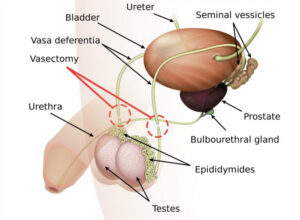
Your urologist (or a member of their team) will briefly review your history and medications, and will discuss the surgery again with you to confirm your consent.
If you are scheduled to have your vasectomy under general anaesthetic, an anaesthetist will see you to discuss the options of a general anaesthetic or spinal anaesthetic. The anaesthetist will also discuss pain relief after the procedure with you.
We usually provide you with a pair of TED stockings to wear. These help to prevent blood clots from developing and passing into your lungs. Your medical team will decide whether you need to continue these after you go home.
Details of the procedure
- If your tubes are difficult to feel, or if you have issues with injections and/or a low pain threshold, we normally recommend a general anaesthetic
- Local anaesthetic causes some discomfort when injected and is like a “bee sting”
- You will need two injections of local anaesthetic, one on each side
- Once this has worked, your skin will be numb and you will not feel anything sharp or painful; you will still feel sensations of touch, hot and cold
- When the surgeon picks up each tube in turn, you may get a little discomfort; this can make you feel light-headed, sweaty and slightly sick but subsides very quickly
- We use absorbable stitches to close the scrotal skin which disappear within two to three weeks
Are there any after-effects?
The possible after-effects and your risk of getting them are shown below. Some are self-limiting or reversible, but others are not. We have listed some important but very rare after-effects (occurring in less than 1 in 250 patients) individually. The impact of these after-effects can vary a lot from patient to patient; you should ask your surgeon’s advice about the risks and their impact on you as an individual:
| After-effect | Risk |
|---|---|
| Mild bruising and scrotal swelling with seepage of clear yellow fluid from the wound after a few days |
 Almost all patients Almost all patients |
| Blood in your semen the first few times you ejaculate |
 Between 1 in 2 & 1 in 10 patients Between 1 in 2 & 1 in 10 patients |
| Troublesome chronic testicular pain which can be severe enough to affect day-to-day activities |
 Up to 1 in 20 patients Up to 1 in 20 patients |
| Significant bruising and scrotal swelling requiring surgical drainage |
Between 1 in 10 & 1 in 50 patients |
| Epididymo-orchitis (infection or inflammation of your testicle) |
Between 1 in 10 & 1 in 50 patients |
| Early failure (post-operative semen analysis shows persistent motile sperms) so that you are not sterile |
 1 in 250 patients 1 in 250 patients |
| Late failure (re-joining of the ends of the tubes after initial negative sperm counts) resulting in fertility & pregnancy at a later stage |
1 in 2000 patients |
What is my risk of a hospital-acquired infection?
Your risk of getting an infection in hospital is between 4 & 6%; this includes getting MRSA or a Clostridium difficile bowel infection. This figure is higher if you are in a “high-risk” group of patients such as patients who have had:
- Long-term drainage tubes (e.g. catheters)
- Bladder removal
- Long hospital stays; or
- Multiple hospital admissions
What can I expect when I get home?
- The local anaesthetic will wear off after four to six hours
- It is advisable to take simple painkillers such as paracetamol, before the local anaesthetic wears off, to help keep discomfort at bay
- We usually provide you with a scrotal support (“jock strap”) to make the post-operative period more comfortable. If you find this difficult to wear, you can use tight, supportive underwear or cycling shorts
- It is advisable to take some simple painkillers such as paracetamol or ibuprofen to help any discomfort in the first few days
- You may find ice packs helpful to reduce pain and swelling in the first few days after surgery (but do not apply them directly to your skin)
- If your bruising, swelling or pain is getting progressively worse, day-by-day, you should contact your surgical team for advice
- Your stitches do not need to be removed and usually disappear after two to three weeks, although this may sometimes take slightly longer
- Try to avoid any heavy lifting or strenuous exertion for the first few weeks
- You will be given advice about your recovery at home
- You will be given a copy of your discharge summary and a copy will also be sent to your GP
- Any antibiotics or other tablets you may need will be arranged & dispensed from the hospital pharmacy
- We will give you information about your follow-up appointments and post-vasectomy sperm counts
Am I sterile straight after my vasectomy?
No, you are not.
It is essential that you understand you are not sterile immediately after the operation. This is because some sperms have already passed beyond the site where the tubes are tied off. These sperms need to be cleared by normal ejaculation. On average, you will need 20 to 30 ejaculations to clear them.
Important information about sperm counts
At least 12 weeks after your vasectomy, you will be asked to produce a specimen of semen for examination under a microscope. Please read the instructions for producing and delivering the specimen very carefully.
If no sperms are present, you will be given the “all-clear” that you are sterile.
If the sample still contains sperm, you will be asked to produce a further sample a few weeks later to ensure that you are clear.
More information is available in the information leaflet about post-vasectomy sperm counts on the BAUS website.
General information about surgical procedures
Before your procedure
Please tell a member of the medical team if you have:
- An implanted foreign body (stent, joint replacement, pacemaker, heart valve, blood vessel graft)
- A regular prescription for a blood thinning agent (e.g. warfarin, aspirin, clopidogrel, rivaroxaban, dabigatran)
- A present or previous MRSA infection; or
- A high risk of variant-CJD (e.g. if you have had a corneal transplant, a neurosurgical dural transplant or human growth hormone treatment)
Questions you may wish to ask
If you wish to learn more about what will happen, you can find a list of suggested questions called “Having An Operation” on the website of the Royal College of Surgeons of England. You may also wish to ask your surgeon for his/her personal results and experience with this procedure.
Before you go home
We will tell you how the procedure went and you should:
- Make sure you understand what has been done
- Ask the surgeon if everything went as planned
- Let the staff know if you have any discomfort
- Ask what you can (and cannot) do at home
- Make sure you know what happens next; and
- Ask when you can return to normal activities
We will give you advice about what to look out for when you get home. Your surgeon or nurse will also give you details of who to contact, and how to contact them, in the event of problems.
Smoking and surgery
If you are having a local anaesthetic, stopping smoking will have no effect on this procedure. Smoking can worsen some urological conditions and makes complications more likely after surgery. For advice on stopping, you can:
- Contact your GP
- Access your local NHS Smoking Help Online; or
- Ring the free NHS Smoking Helpline on 0300 123 1044
Driving after surgery
It is your responsibility to make sure you are fit to drive after any surgical procedure. You only need to contact the DVLA if your ability to drive is likely to be affected for more than three months. If it is, you should check with your insurance company before driving again.