
What does this procedure involve?
Filling your bladder with fluid through a small, soft catheter (tube) and measuring how your bladder responds to filling; we also measure how well your bladder works when you pass urine.
Your doctor or nurse will only refer you for urodynamic studies if they feel the test is important in deciding how to manage your symptoms. Sometimes, the doctor who specialises in bladder problems and does the urodynamic testing, may feel that the test is not actually needed at this stage.
In this event, you will be able to use the scheduled test time for a detailed discussion of your bladder problems with this specialist.
What are the alternatives?
There are no real alternatives to urodynamic studies, apart from treating you without the information that this test might provide.
What happens on the day of the procedure?
Your urologist (or a member of their team) will briefly review your history and medications, and will discuss the procedure again with you to confirm your consent.
IMPORTANT: Please stop any drugs you are taking for your bladder symptoms. These include oxybutynin (Ditropan™), tolterodine (Detrusitol™), solifenacin (Vesicare™) and mirabegron (Betmiga™).
If you cannot stop them for any reason, please let the doctor, nurse or technician know when you attend for the test.
You must let the staff know if you have any allergies, especially to latex.
We usually ask you to come for the procedure with a comfortably full bladder. This allows us to:
- measure your urinary flow rate – before we carry out the urodynamic studies; this involves passing urine into a special machine; and
- test a sample of your urine for infection using a dipstick – if there is evidence of infection, we usually postpone your procedure for a week or two and give you a course of antibiotics to take home. You may be asked to leave a urine specimen with your GP a week before the test, and to let the urology team know the result before your test.
Details of the procedure
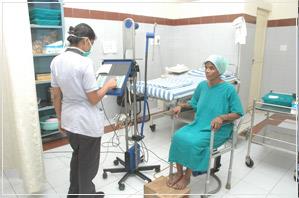
- the test is usually performed by a urologist, specialist nurse or technician
- if X-ray screening is being used, there will also be a radiographer present
- you will lie on a couch and we will pass a fine plastic catheter (tube) through your urethra (waterpipe) into your bladder: sometimes, this catheter is passed through your tummy wall (if you have a suprapubic catheter) or through a Mitrofanoff channel
- if, as occasionally happens, we cannot pass a catheter into your bladder, you may need to have one inserted, usually at a later date, using a fine telescope (flexible cystoscopy) before the test can be carried out
- we put a second, fine catheter into your rectum (in men and most women) or into your vagina (in some women)
- if you have a bowel stoma (ileostomy or colostomy), the second catheter may need to be put into your stoma so you should bring a spare stoma bag with you
- once all the catheters are in place, they will be taped to your leg and connected to a computer system which measures the pressures
- we may do the test with you lying on a couch, sitting or standing
- we fill your bladder slowly with saline (salt) solution through the catheter
- we ask you to cough or strain during the test and to tell us when you first feel a desire to pass urine
- if one of your symptoms is incontinence (leakage), we will try to reproduce this using a variety of measures. Do not be embarrassed about this; the clinical team will be as supportive as they can and will respect your dignity throughout the process
- we will encourage you to hold on until your bladder feels very full
- to finish the test, we ask you to pass the fluid in your bladder into a flow-rate machine again
- if you are having a videourodynamic study, we fill your bladder with a liquid contrast material (dye) instead of saline solution, so that we can take X-ray pictures throughout the test
- we then remove all the catheters and you can wash and dress yourself
If a urologist has been overseeing the procedure, he/she will discuss the results with you and advise on treatment. If no urologist is available, we will arrange an outpatient appointment for you to discuss the results. You can then discuss treatment options with your urologist.
Are there any after-effects?
The possible after-effects and your risk of getting them are shown below. Some are self-limiting or reversible, but others are not. We have not listed very rare after-effects (occurring in less than 1 in 250 patients) individually. The impact of these after-effects can vary a lot from patient to patient; you should ask your surgeon’s advice about the risks and their impact on you as an individual:
| After-effect | Risk |
|---|---|
| Burning and discomfort on passing urine |
 Between 1 in 2 & 1 in 10 patients Between 1 in 2 & 1 in 10 patients |
| Blood in your urine |
Between 1 in 2 & 1 in 10 patients |
| Infection in your urine requiring antibiotics |
 Between 1 in 10 & 1 in 50 patients Between 1 in 10 & 1 in 50 patients |
| Inability to pass the catheter into your bladder, so the procedure has to be abandoned and further tests need to be arranged |
Between 1 in 10 & 1 in 50 patients |
| Retention of urine (inability to empty your bladder) requiring a temporary catheter to be put in your bladder |
 Between 1 in 50 & 1 in 250 patients Between 1 in 50 & 1 in 250 patients |
| Failure to find the cause of your symptoms requiring a possible repeat of the test at a later date |
Between 1 in 50 & 1 in 250 patients |
What is my risk of a hospital-acquired infection?
Your risk of getting an infection in hospital is between 4 & 6%; this includes getting MRSA or a Clostridium difficile bowel infection. Individual hospitals may have different rates, and the medical staff can tell you the risk for your hospital. You have a higher risk if you have had:
- long-term drainage tubes (e.g. catheters);
- bladder removal;
- long hospital stays; or
- multiple hospital admissions.
What can I expect when I get home?
- you should drink plenty of fluid for the first 24 to 48 hours to help reduce the risk of urine infection
- we give antibiotics afterwards to some patients, mostly those who have a high risk of infection; any antibiotics or other tablets you need are usually arranged & dispensed from the hospital pharmacy
- you will be given a copy of your discharge letter and a copy will also be sent to your GP
- if you were not seen by your urologist on the day of the test, we will make a follow-up appointment for you with your urologist, to discuss the results of the test and to advise you about further treatment
General information about surgical procedures
Before your procedure
Please tell a member of the medical team if you have:
- an implanted foreign body (stent, joint replacement, pacemaker, heart valve, blood vessel graft);
- a regular prescription for a blood thinning agent (e.g. warfarin, aspirin, clopidogrel, rivaroxaban, dabigatran);
- a present or previous MRSA infection; or
- a high risk of variant-CJD (e.g. if you have had a corneal transplant, a neurosurgical dural transplant or human growth hormone treatment).
Before you go home
We will tell you how the procedure went and you should:
- make sure you understand what has been done;
- ask the surgeon or nurse if everything went as planned;
- let the staff know if you have any discomfort;
- ask what you can (and cannot) do at home;
- make sure you know what happens next; and
- ask when you can return to normal activities.
We will give you advice about what to look out for when you get home. Your surgeon or nurse will also give you details of who to contact, and how to contact them, in the event of problems.